Archive for the ‘photography’ Category
The “Candid Moment [with] a Story Behind It” —Eric Kim

Logo for Leica Camera (Photo credit: Wikipedia)
Only a few days back we blogged about a photographer from South Korea who cut his teeth in America. Today we bring to you a photographer from America who has a portfolio on South Korea. The ‘contrasts’ continue: the South Korean photographer shoots in a derivative, personalized ‘fine art’ style while the American espouses a more documentary, hard-edged, ‘classic’ street shooting style. As street shooters, though, both have one thing in common: a love of Leica.
Though this Leica interview is from May 2011, it’s worth checking out Eric Kim: Korean Street Photographer from Los Angeles as a sharp ‘contrast’ to The “Fine Art Street Photography” of K. Chae.
The phrase “candid moments of everyday life” defines Kim’s style well and the sentence “street photography . . . is less about the image but more about the story behind it” completes the definition as it distinguishes his style from Chae’s. This photograph of two women sharing an umberella on a rainy night (somewhat reminiscent of Brassai?) is the exemplification of Kim’s street shooting philosophy.
Check out this somewhat Cartier-Bresson’ish image (a very high compliment, yes). The static pose of the mime (or statue, whichever it is) is set off wonderfully by the moving woman, with the viewer’s eye enjoying a further distraction in the geometric lines and curves of the interior architecture.
Here’s something radically different: an overtly geometric, symmetrical and artistic photograph. This image also projects a sense of direction: notice the narrow beams of light in the top half of the image and the broader ones at the bottom (both of which are laterally symmetrical and directed upwards), the movement of the bicyclist, and the arrow at the bottom.
Kim is also an active blogger who plugs other photographers, offers tips, and announces his workshops. You may want to read a few tips or attend a workshop if you want to capture a “candid moment [with] a story behind it” as in this delightful image.
Going back to Kim’s definition of his style, perhaps he is more versatile than he thinks he is: doesn’t this sharply gradated, evocative, unusual silhouette count as . . . ‘Fine Art Street Photography’?

Ideas from Two Pros . . . and Caveats about Going Pro
One month back we published an article about photographers drawing inspiration from works of art. Coincidentally, earlier today, Gina Milicia wrote, “Some people will tell you that it’s wrong to copy but for centuries, every generation of artist has imitated the masters before them” in an article about ‘5 Fail Proof Portrait Poses’.
It is more of a post than an article but Milicia gives a few sharp and unusual suggestions and illustrates each with a photo. Her post is not so much about static poses as commonly understood but includes dynamic ‘poses’ as well. The aim is to relax a self-conscious subject and get him/her ‘loose’. One suggestion: ask your subject to jump for joy!
Richard Bram is similar to Milicia in that he photographs people but dissimilar in that he shoots candids, “the quirkier moments in the events I was covering [which became the] beginning of the edgier street photographs,” as quoted in this interview with Bram on the Leica Blog.
Bram’s experiences in PR and personal bent are such that street photography is only one area that appeals to him – travel and musicians are also of interest to Bram.
This lengthy interview is worth reading for the in-depth ideas it conveys about a particular photographic approach and style in which the background is of vital importance and whose ultimate goal is to capture “the significant gesture.”
Bram says, “One evening at a party, I told a friend who’d run a fine art photography school in Louisville that I was thinking of becoming a photographer.” If you are harbouring the same intentions, then before taking the plunge, read 10 Myths About Being a Professional Photographer by Ron Longwell.
Many of Longwell’s ‘heads-ups’ are spot-on and to-be-expected, like “Professional photographers get to set their own schedule.” Yet others are equally spot-on but are surprising eye-openers, such as “The market is oversaturated with photographers.” Isn’t it good to know that that is a myth?!
One or two of Longwell’s ‘myths’ are a bit odd. For instance, “I need professional camera gear to be a pro photographer.” Hmm, methinks you do need pro gear if you’re going to be a pro . . . better not turn up at that ad agency shoot with a Coolpix or Cyber-shot – else that may be the first and last day of your pro career!
Sentimental, Solitary, and Sunrise Galleries

Sunrise over Stonehenge on the summer solstice, 21 June 2005 (Photo credit: Wikipedia)
Let’s take in three very different kinds of galleries all beginning with ‘S’: a Sentimental fad that’s catching on; next, a Solitary road trip; and third, a Sunrise ‘Best Of’.
Sentimental: “Dear Photograph”
If you haven’t heard about Dear Photograph yet, you would soon have. This (sickly?) sentimental site is becoming a popular fad to the extent that prestige publishers Taschen have published a book about it!
Dear Photograph quotes TIME as saying, “that idea is taking a snapshot . . . and holding it up against the original setting so that past and present blend into a new work of art.” That description is mostly correct except for the last three words as ‘art’ is nowhere to be found though navel-gazing and self-indulgence are found in abundance.
Wait for the owners of the site to whip it up a la Instagram and then cash out with a multimillion-dollar sale to Google or the like!
Solitary: Slicing across America
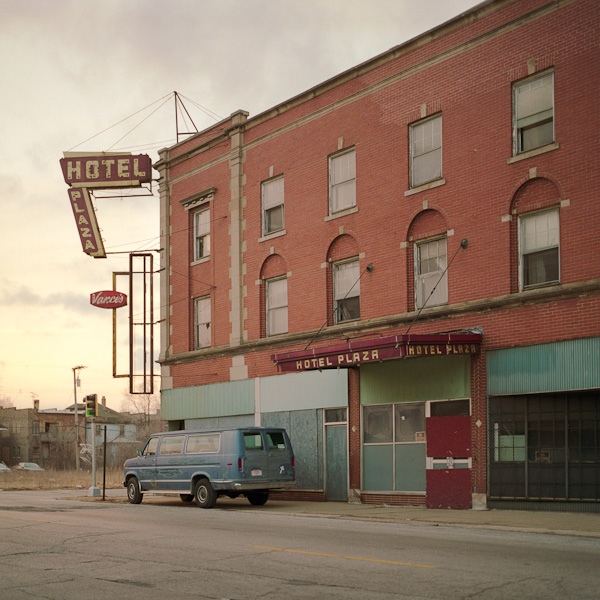
Unlike Dear Photograph which boasts about art, The Great and Ghostly American Road Trip, shot by Walker Pickering, does not. Yet it’s infinitely more artistic than Dear Photograph. Consider this moody image of this bit of America frozen in time.
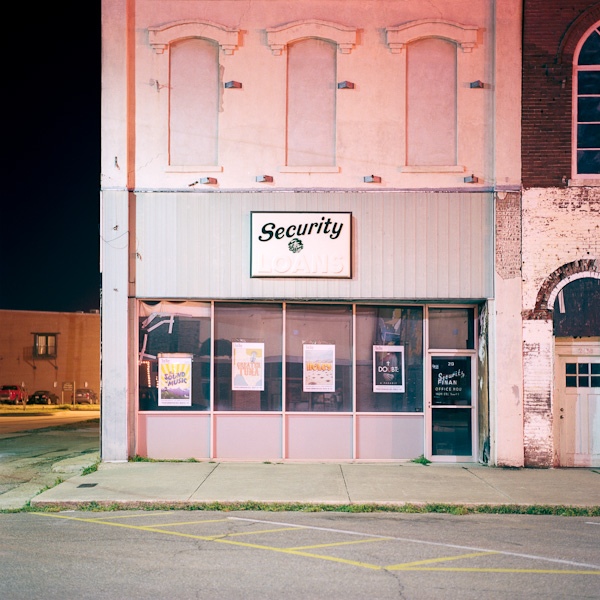
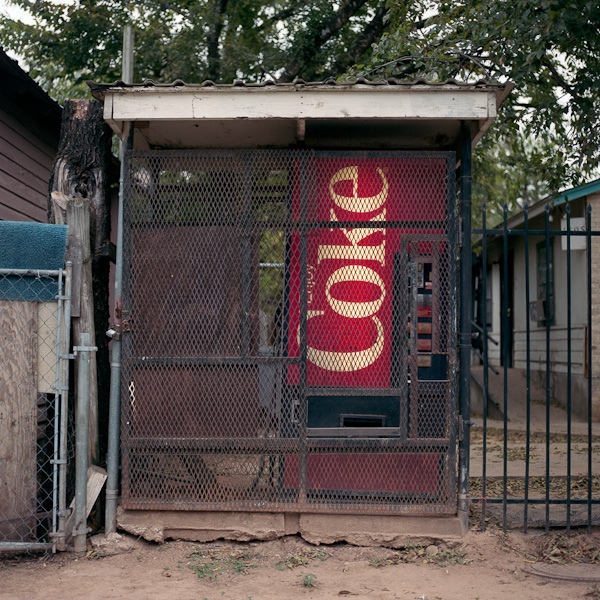
If that’s not to your taste, how about a barren, lonely store coloured powder-puff pink against a backdrop of a dark night? If you’re looking for people, you won’t find any in Pickering’s photographs of a deserted American countryside where you will find a caged, captive vending machine.
Dear Photograph also quotes TIME as using the word “evocative” for itself. Look at ‘American Road Trip’ and see whether that word is better applied to the photos in this gallery.
Sunrise: Fine Photography
Those words, “. . . work of art” – though one cannot find that in Dear Photograph you can find a few in ePHOTOzine’s Ten Top Shots taken at Dawn. Here are three favourites. First, this one of waters that seem to be both soft yet raging depending on where you look, in an image has leading lines, contrast, textures, and foreground and background interest.
This gallery is mostly about light, of course, considering that the subject is dawn. Here, though, is a colour photograph with a very narrow set of tints or a limited palette that entices the viewer into the scene. Again, leading lines have something to do with beckoning us into this misty dream.
Dawn (and twilight) is about the ‘Blue Hour’ and the hour after that is the ‘Golden Hour’. Here’s a photograph that captures the transition from one to other. While the sky and the light is clearly a cool blue, the horizontal rays of the rising sun impart a golden radiance to the earth and rocks to create a photograph of delightful ‘cleanness’ and clarity.

Some Nice Things we Missed

logo of cokin (Photo credit: Wikipedia)
Sometimes the news flies so thick and fast that items deserving of a look get over-looked. Let’s take in a few such interesting items from the past week or two.
Dissing Digital
Norman Jean Roy is a fashion photographer ‘on the make’. He has shot both George Bush and Kate Beckinsale and his images have graced both Vogue and Vanity Fair. Two weeks back FStoppers published an interview with Jean Roy in which he talks about his philosophy of photography and his take on the camera as a neutral instrument.
Though he shoots digital too, Jean Roy claims to favour film: because it does not have the same instant gratification as digital, it alters for the better the way one approaches a shoot.
Jean Roy says that perfection in photography is destroying it as an art, and he blames digital for introducing the capability of perfecting photographs, ergo digital is killing photography as an art in general and fashion photography in particular.
Rich, Thin Filters
New York socialites say, “You can’t be too rich or too thin.” Cokin has adopted that battle cry for its Pure Harmonie series of filters: Cokin says they’re the thinnest filters in the world! Filters available currently are a UV, a Polarizer, and a Variable Density Neutral Gray.
These filters begin at $50 and go up from there. Just like those New York socialites, these lenses favour those who are . . . ‘rich’!
Another Type of Filter
We’ll close with the sort of filter that is integrated into most modern cameras; anti-aliasing filters that suppress moire. Digital imaging has sharply-defined limits of resolution by frequency (as opposed to film) – because, after all, unlike film, the image is resolved on a grid of pixels – therefore, it interprets certain patterns, such as fine checks on clothing, incorrectly and introduces banding effects.
Anti-aliasing filters eliminate moire patterns at some cost to image quality and they’re a standard part and parcel of digital cameras and other digital imaging equipment.
Fujifilm, like Leica, decided that there was a way to eliminate moire without anti-aliasing filters. This technological step, however, prompted a photographer to compare Fujifilm’s decision to building a sports car without brakes! Is that a valid comparison or a total exaggeration?

A Tour of East Asia with Messy Nessy Chic

Coat of Arms of North Korea (Photo credit: Wikipedia)
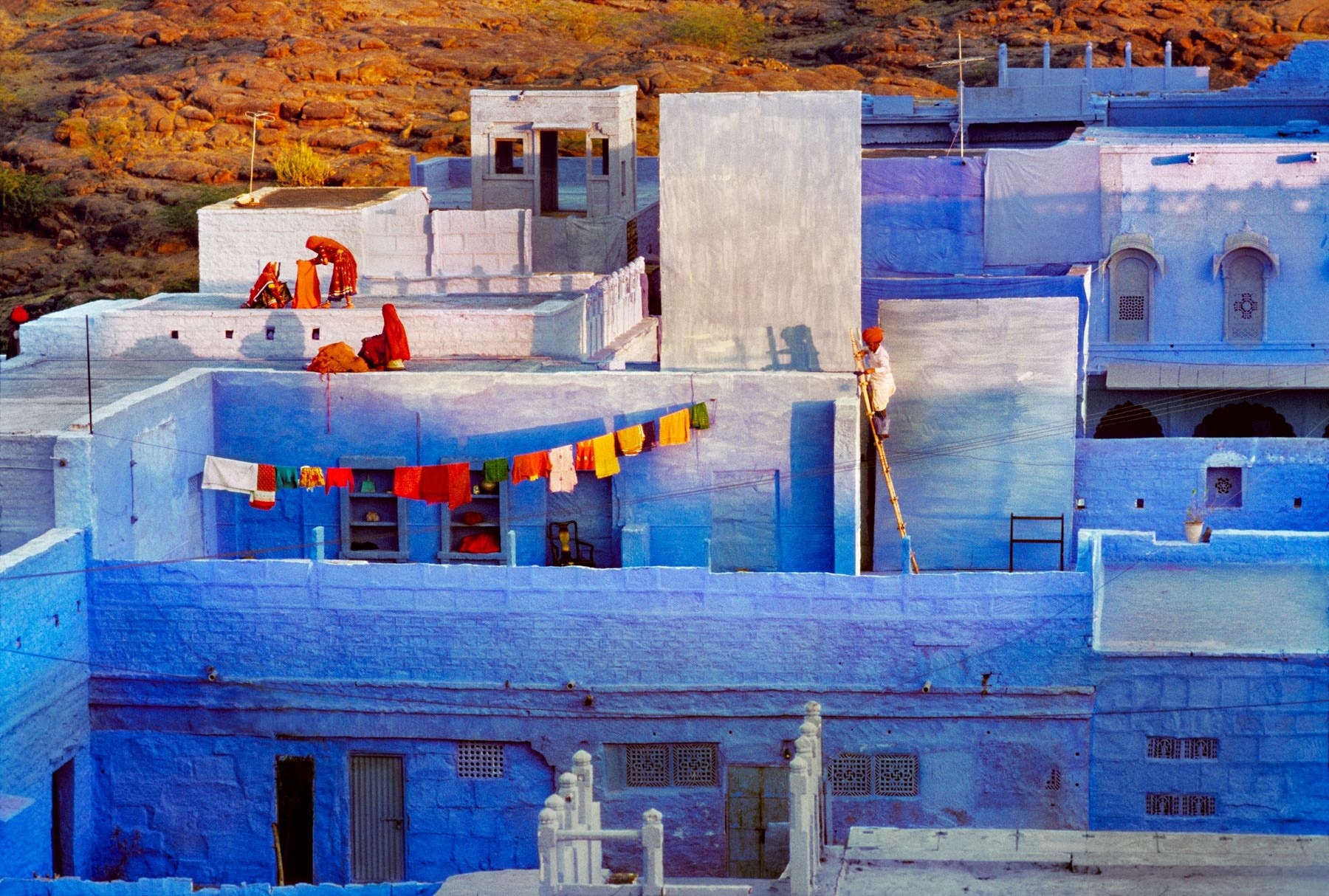
Step aside Picasso and your ‘Blue Period’, here’s famed NatGeo photog Steve McCurry with his ‘Blue Period’ – with a little help from Jodhpur, India. Messy Nessy Chic serves up a charming set of photographs in their photostory Steve McCurry’s Blue City.
Unlike a painter’s palette, a photographer doesn’t have much control over his ‘palette’. While Nature photographers, of course, can work with a green-based palette, a blue-oriented palette is a rarity so this delightful one is especially enjoyable.
Here are three figures, none facing the viewer, in an image that is photojournalistic, artistic and serene all at once, and that tells a little story.
The locals seem to have a yen for reddish hues (besides – at it again – playing chess).
Here’s one that’s a joy in its activity, the composition, the strip of colour, the swath of clay-brown, and – natch – the shades of blue.
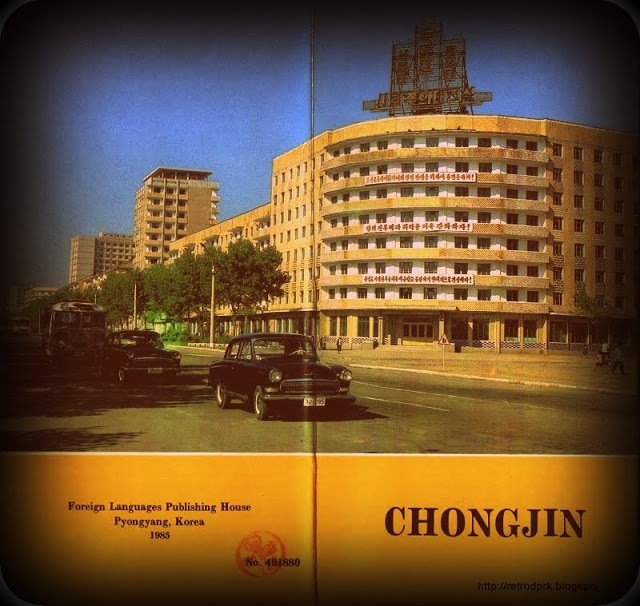
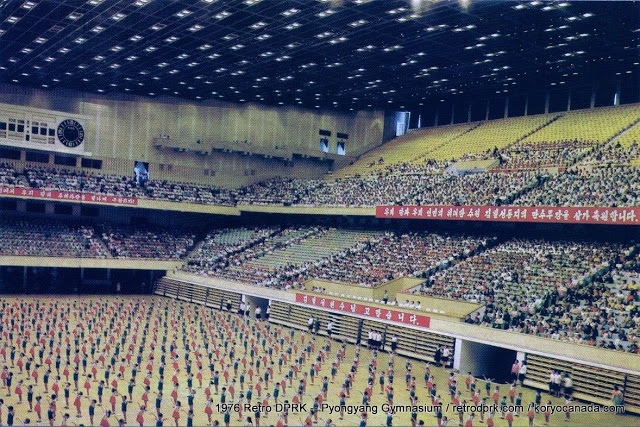
Staying in the East Asia and with Messy Nessy, you’ve heard of the Forbidden City but what about the ‘Forbidden Country’ – North Korea – from back in the 1970s?
Here are some ‘Postcards’ showing a way of life that is quaint, universal and charming at turns, plus what we have come to see as being classically Communistic.
The photographs are not works of art here, what’s of value is the rarity of the underlying images which show, both, a secretive country from a bygone age, albeit in such colours as were permitted by the authoritarian powers-that-be.
Still staying with Messy Nessy and in East Asia, let’s close our tour in Japan – we have ‘Postcards’ once more, these of Apprentice Geishas.
Don’t these girls seem mature behind their years? And these? Does this one appear old before her time?
A Prozac victim had titled her biography, ‘Girl Interrupted’. Can we call geisha girls (and others in similar circumstances) ‘Girl Accelerated’?
Be that as it may, as the title of the article says, a few of these photographs are indeed ‘haunting’.

The Good, the Mad, and the Chuckly
This post has nothing to do with Spaghetti Westerns starring Clint Eastwood; it’s about a troika of articles on PetaPixel which make up our (near-)weekly set of all that’s quirky and offbeat in Photography News. This week: The Good, the Mad, and the Chuckly.
The Good
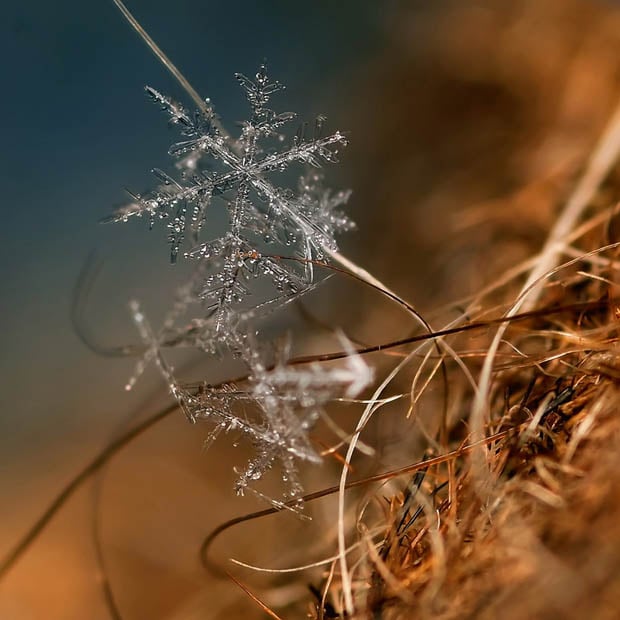
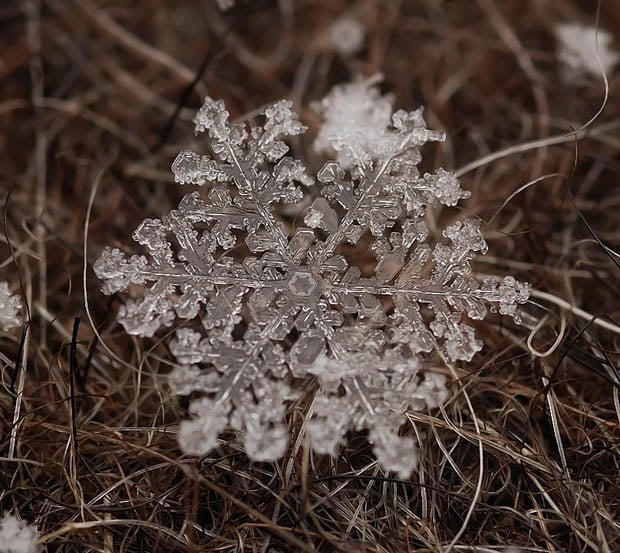
Ethereal Macro Photos of Snowflakes is about the unusual and marvellous art of Russian photographer Andrew Osokin.: photgraphing individual snowflakes.
‘Ethereal’ is the word for captures like this one, straight out of Fairyland. PetaPixel assures us that no trickery is involved, stating that all images are macro photographs.
You’ve heard this before, now see it for yourself: isn’t the wondrous breadth and diversity in the tiniest aspects of nature breathtaking? Compare this intricate detailwork to the delicate fragility seen in this snowflake, both crafted by a master lapidary. Thanks to Osokin for preserving fleeting, ethereal beauty.
The Mad
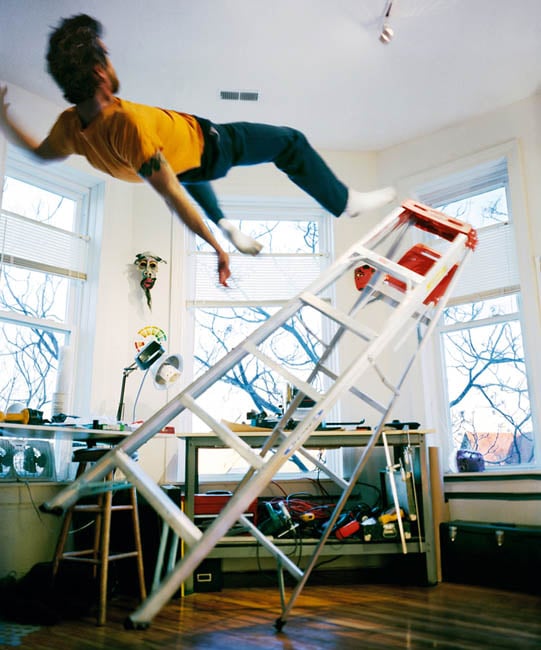
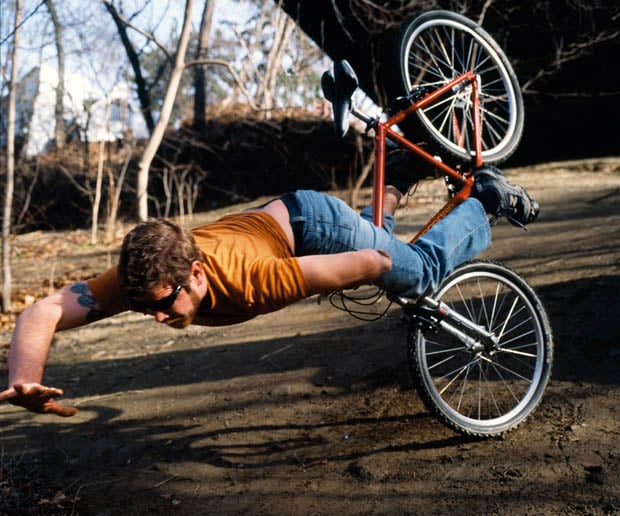
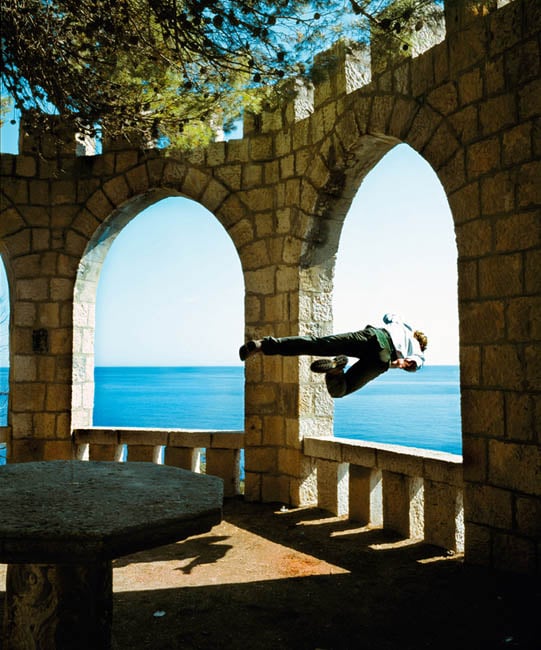
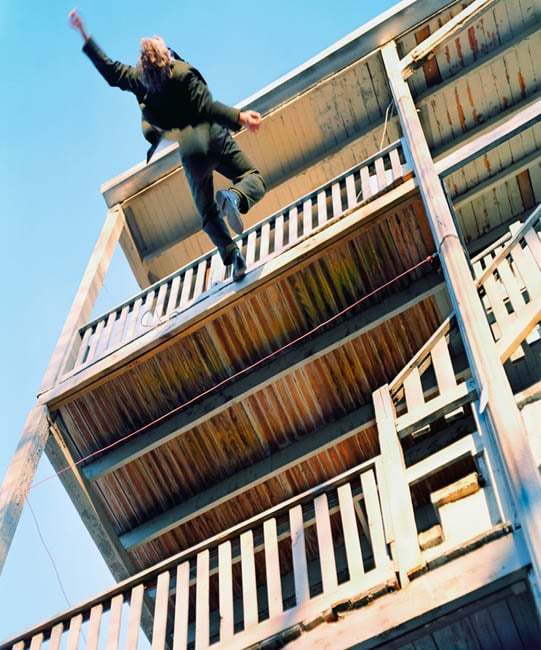
Is Kerry Skarbakka mad? After all, he photographs ‘self portraits’ in the act of . . . falling! If asking whether Skarbakka is ‘mad’ sounds rude, consider that PetaPixel writes, “. . . you find yourself worrying about Skarbakka health… and sanity” in Photographer Shoots Scary Self-Portraits.
The opening shot shows a man in midair falling off a toppling stepladder!
Here too little Photoshopping is involved: “His trick is that he uses climbing gear, ropes, and other rigging in order to stop his fall before his body actually makes painful contact with the ground” but “when all else fails, he admits to editing out glimpses of his safety gear during post-processing.”
The man’s talents are not limited to photography and falling, he’s a trick cyclist and apparently he can levitate too. Let’s say ‘goodbye’ to Skarbakka with this fine suicide shot.
The Chuckly
Trust New York and New Yorkers to do wacko things that would make the rest of us (more normal people, shall we say?) chuckle and giggle.
Evidently the whole business of not-so-well-heeled diners at Noo Yawk’s de luxe establishments taking quickie snapshots of their entrees and then posting the results on Facebook or wherever is totally out of control now. So much so that several New York restaurants are banning the practice, as reported by PetaPixel in Upscale Restaurants are Starting to ban Food Photography.
That story piggybacks on an NYT story, Restaurants Turn Camera Shy which reports a spokesman as saying, “It’s reached epic proportions. They don’t care how it affects people around them.” He has a point; such behaviour is unmannerly. Throw the bums out!
Top Ten Photography Books for 2012
England’s The Independent has published a list of its Top Ten Photography Books for 2012.
Probably not surprisingly, a book celebrating the charms of London tops the British daily’s list. The newspaper’s website incorrectly identifies it as ‘London Street Photography’; the correct title is London, Portrait of a City. This looks like a gorgeous photo book with images of arguably the world’s premier, most diverse, city so let’s not quibble over this book’s top ranking.
You know about the British Royals and the Swinging Sixties but if you’re curious about “foggy, cobbled streets” and “Hoxton Hipsters,” this picture book’s for you.
What leaps out from the Independent’s list, compiled by Will Coldwell, is the name Franz Lanting, who is at number 3 with Okavango. Here is the publisher’s product page.
Okavango is far from a new book; it was published over a decade back. The present edition is “updated and expanded” and “further enhanced” and clocks in at 250 pages. Lanting is the wildlife photographer who manages to bring to the fore a serenity, balance, and an ‘in the greater scheme of things’ feel to wildlife images.
Let’s stay with the odd numbers (like the more hidebound Beethoven fans) and proceed to no. 5, Kodachrome. Coldwell says: “To mark the 20th anniversary of the death of Italian photographer Luigi Ghirri, Mack has produced a second edition of the first book he self-published in 1978.”
One wonders whether the word ‘death’ so closely following the title ‘Kodachrome’ was a Freudian Slip or well-meant with irony – with a Brit one never knows! But anniversaries of death may just as well apply to Kodachrome now.
From (unintentional?) irony to strange coincidence: in our post of three days back we had blogged about Steve McCurry and the last roll of Kodachrome, and now on Coldwell’s list we have McCurry following Kodachrome in the next odd-numbered position, 7. (No, on this blog we’re not in thrall to popular Beethoven doctrine; we believe that the ‘Evens’ are exceptional in their own, less dramatic, but more tranquil and contemplative, fashion.)
McCurry is to people and portraits what Lanting is to wildlife. His Steve McCurry: The Iconic Photographs is a monster of a book at 380 x 275 mm and 272 pages. The book’s page on Phaidon’s website contains a slideshow of several captivating people photographs. Also available is a signed limited edition with a signed print.
Bucking the ‘Odd’ trend, we skip number 9 to jump to number 10, and with good reason: there is no ‘Joy’ a la the Ninth for persons who are hunted like animals by predacious paparazzi, and on tenth spot is a book featuring photos taken by those predators: Famous: Life Through the Lens of the Paparazzi.
The photos may be delightful; the means by which they were taken surely are not; Thames & Hudson’s product page frankly describes the book’s photographs as “a star-studded selection of those who live their lives in the spotlight, sometimes welcoming the camera, sometimes pursued by it.”
Big game hunters pursue their prey using the barrel of a gun; these hunters do it with the barrel of a telephoto lens. When you admire their ‘shots’, spare a thought for their prey – may they rest in peace!
May Ronen Goldman ‘Live in Interesting Dreams!’
Let’s pay a visit to the René Magritte of Photography: an unique photographic artist, Ronen Goldman.
Goldman is not, per se, a great photographer; he’s a great creator of situations, sets, scenes, tableaux, most of which are, let us say, ‘dreamlike’. How does he do it? All he does is translate his dream into reality – and then photographs it! Haven’t you always wanted to do just that?!
The slumberous inspiration for the photographs gives rise to the project’s name: The ‘Surrealistic Pillow’. Here is where you’ll find fishbowl heads, iguana-laden beds, balloon’ish lanterns, apple barrages, fruity hail, guitar-filled woods, a bench with Kali Ma’s multiple arms, and other photographs that are just too weird to even describe!
The images clearly look like photographs but, even without any special effects Photoshopping (as opposed to the obvious combining and accumulation of discrete photographs and photographic elements), some have a painterly, feel. This arises no doubt because of the nature of the image itself: one is accustomed to seeing ‘unreality’ in paintings whereas one is equally accustomed to seeing reality in photographs.
There’s more to these photographs than immediately meets the eye: though the origin of these images – dreams – suggests a novelty project, these photographs are more than a novelty. That’s because Goldman concentrates his attention and shifts the emphasis from creativity in-camera when making the shot and creativity on the computer when post-processing to ‘creativity a priori’ – well before making the shot. What a concept in the Age of Photoshop!
Also, a few photographs are truly good enough to decorate a lobby. Consider the photograph of a girl lying on a pathway leading to an ivy-covered castle with hands emerging from bushes along each side, trying to reach the immobile girl. Leaving aside whatever Freud or Jung may have to say about this particular scene, this photograph is superbly executed and stands as a work of art.
Ronen Goldman had a really good idea and he has been executing it equally well. Let’s take a twist on that Chinese greeting and wish that ‘he lives in interesting dreams’!
The Guardian’s Best Photographs of 2012
Having seen the photographs our press have chosen as their ‘Best Photographs of the Year’, it may be interesting to compare what the media mavens in Old Blighty and those across the (big) pond over in America consider to be their Photos of the Year, courtesy of The Guardian and TIME respectively.
We’ll cover The Guardian’s selection in this post, specially the dramatic and dynamic images, and review those of TIME in today’s post on our sister site.
Unlike TIME’s 366-photograph smorgasbord, The Guardian provides a far smaller selection of what are for the most part photojournalistic and editorial images, a few of them with considerable impact. Like the very first one showing half the island of Manhattan plunged in darkness. Compare with another aerial shot of another city – Aleppo – that was plunged in darkness but for very different reasons: shelling and bombs.
The newspaper seems to have asked the photographers behind the chosen images to write a few lines describing the ‘whats’ and ‘wheres’ of their images, plus what they mean to them. Though these textual vignettes are sometimes self-glorifying or try to put over a less-than-first-rate photograph, at other times they shed light on a cryptic or amusing image – like this one of, shall we say, ‘Bathing Beauties Chinese Style’? The photo and the mini-story complement one another very well.
The vignette, though so well-written, is superfluous for this brilliant shot evoking pure joy; indeed, a sense of euphoria, at an Obama election rally. Likewise for another Obama photograph: a lovely photograph of a heartfelt embrace between man and wife. This would be, and is, a wonderful photograph regardless of who the subjects are.
The very next image, possibly the most carefree and dynamic one in the gallery, is one for which the photo and the description play off one another. (Indeed, a very similar photograph of Palestinian Parkour was featured in one of our posts.)
Not to be missed is another photograph from the Islamic World. Would you believe a brilliant blue burqa and an array of laserlight speckles dotting the frame makes for an exceptionally pretty photograph? Compare with a photograph with another kind of ‘speckles’ – real sparks from real flames. That’s what this horseman is riding through in a very dramatic image of a religious festival in a remote Spanish village.
If these dynamic and dramatic images are not to your taste, you’ll find more sober ones if you browse through the gallery. So go ahead, with our Best Wishes for 2013 to all our readers.
Top Tutorial: Dynamic Landscape Photography
What Everybody Ought to Know About Landscape Photography [Best of dPS 2012] is one of those year-end roundups. Obviously, it is about landscape photography and is actually a Top Ten list of tutorials. They are listed “in no particular order” with Composing Dynamic Landscape Images at No. 1, the top of the list.
And, boy, is it a ‘Number One’ ‘Top of the List’ tutorial! Photography is primarily an art, not a science, a method, or a mechanical approach. To the great credit of Todd Sisson, he manages to show the scientific, methodical and mechanical underpinnings of ‘an art’, or how to create a work of ‘an art’ (i.e. a fine dynamic landscape photograph).
Sisson modestly states “It must also be stated that what follows is not a recipe for creating great images” but if so, then what he provides is and ‘almost recipe’. The ‘almost recipe’ has seven ‘ingredients’, from “Leading or converging lines” to “Suggestion of movement”, listed right up top. Sisson dissects and explains the purpose of these factors, and illustrates them with numerous superb images.
The author’s insight and understanding into how most persons interact with and react to a landscape photograph, and how the eye responds to lines, light/dark areas, intensity/saturation, foreground/background, perspective, etc. and his ability to get concepts and facts across lucidly, is unparalleled.
This knowledge, and the ability to communicate it effectively to the reader allows one to go ‘aha!’ and grasp the nebulous principles of just what makes for a top-notch dynamic landscape photograph. There is little doubt that this tutorial will take many intermediate landscape photographers to the next level.
Readers of this blog will know that we’re not given to superlatives here but this tutorial is quite exceptional. What’s more, Sisson’s quirky sprinklings of humour make an exceptional how-to highly readable. (“Try scrambling up banks, standing on cars and sitting on your wife’s/husband’s shoulders (sans tripod)”; “run around like a deranged prison escapee,” “mind-control experiment deployed by shady branches of the US intelligence community!”)

 Follow us on Facebook for all the latest in canvas printing news and exclusive deals!