


Archive for the ‘photography’ Category
Street Shooting — and ‘Home Shooting’!
If you’ve got into the groove of ‘street shooting’, it’s no big deal to you. But if you haven’t, the idea of pointing your lens at strangers may seem a little intimidating.
In The Ethics of Photographing Random Strangers on the Street, Ming Thein provides, not only a sketch of the ethical issues involved, but, tips and techniques as to how to go about doing something that, according to him, “requires balls.”
The idea behind street shooting is to document a ‘slice of life’; to capture the unguarded moment. For this reason, stealth is important; as Thein puts it, “the more subtle issue of ‘quantum mechanics’ . . . if you become a participant in the image, then the reaction you provoke from your subjects will necessarily disrupt whatever it was you initially wanted to capture.”
And that is the heart and soul of authentic street shooting. The article lays out a few ‘hows’ and Thein explains what works for him. To his tips one may add: either remain still or be constantly on the move, do not follow anybody, ensure that flash is off, wear clothes that make you invisible, and don’t look like a photographer – look like a darn tourist!
If street shooting’s not your cup of tea and Thein fails to convince you to take the plunge, let John Gravett show you how you don’t even have to stray from home to capture some amazing images in Photographing Household Objects.
Gravett’s imaginative techniques allow you to create fascinating, abstract, images without using anything more specialized than a sheet of polarizing gel or macro lens!
Shooting plastic cutlery through a polarizer introduces a delightful effect of interlacing colours. (Note how Gravett arranged the cutlery and composed his shot.) How about giving the same treatment to a textured or embossed plastic bottle?
The techniques Gravett brings to bear on a paperweight and a Slinky are nice but the pick of the bunch has to be his experiment with water, oil, colour paper and angled flash. Not only are the forms, colours and ‘scene’ quite arresting, the final image makes for quite a pretty artwork that NASA may like to post on its website, if only to befuddle an astronomer or two!
Merry Christmas to all our readers!
DP School’s Top Tutorials for the Second Half of 2012
If you’re a photographer, you know about DP School. Two days back they listed their fifteen most popular tutorials from the latter half of 2012, during which time they published about 300 such tutorials.
Fifteen out of 300 – we’re looking at the top five percent.
The fifteen how-tos are a seriously varied bunch – one tutorial may appeal to the rank newbie; another to the experienced pro.
The top ‘how-to’ is one that seems counter-intuitive; in fact, it is a justification or discussion rather than a how-to: Why Your Kit Lens is Better than You Think. In second and third place are Posing Guide: 21 Sample Poses for Photographing Women – Part 2 and 8 Tips for Long Exposure Photography respectively.
A good lens from a top maker, say Zeiss, or even a high-end offering from your camera’s maker itself is always going to be an improvement on your kit lens, isn’t it? Andrew S. Gibson tries to argue otherwise. The gist of his discussion is that you should see your kit lens as a wideangle and a short telephoto two-in-one. Oddly enough, his counter-argument is stronger. He goes on to list the drawbacks of kit lenses, the biggie being the small ‘hole’. Basically, Gibson is paraphrasing John Lennon: “Give Kit-Lens a Chance.”
The posing guide has line drawings to get you started on posing your subject/model. One point this how-to completely misses is accounting for the age and body-shape of your female subject. A pose that will work beautifully for a particular age and body-shape can look funny and contrived for another, so keep that point in mind. For example, no. 6 is an all-purpose pose that will work out well with mature and/or well-built women. It won’t be a great choice for a slim teen, though, and may look artificial. No. 13 will be great for willowy young women but is to be avoided if your subject is mature and well-built.
Things get really interesting with the Long Exposure tutorial (which has briefly been mentioned in an earlier post). It is not so much about night photography as about using ND filters to force long exposures to smooth out water, create cloud streaks, and so on. This how-to has some useful tips. For instance, while Tip 3 is well known to old hands, Tip 2 – ND filters throwing off the AF sensor/mechanism – is a very sharp one. The author’s tips clearly come from a photographer with experience in the field – take “Choose the right conditions.” This is not a tip that one could readily anticipate.
Three of the most valuable, interesting, or unusual tutorials fall right at the end of the list, so don’t miss out the ones that teach you how to read a histogram (valuable), creating backlight/hairlight with natural light (interesting), and doing away with fear of street shooting (unusual).
Beyond HDR: Deschaumes’s ‘Extreme Landscapes’
First, there was dodging and burning. Then, there was Ansel Adams. Then came HDR. And now we have Extreme Landscape Photography and Alexandre Deschaumes. Not only that, but Deschaumes does it the natural way and the hard way, setting out for remote and inaccessible places and bringing back photographs that take on the quality of moody paintings and even dreams.
Deschaumes has two sets of online portfolios, one on SmugMug and the other on 500px. As you will find, a few of the images are like both, moody paintings and dreams.
Check out Opalescent Dream for a very different kind of mood (than the image linked to above); these photographs would have made ideal backdrops for a few scenes of the LOTR movies. This gallery has to be seen for some of the most delicate hues and textures in landscape photography.
Here is a radically different ‘evocation’ of the same subject matter, brilliantly composed. In that same gallery is this spellbinding image of a mountaintop lake which truly defines ‘Extreme Landscape Photography’.
What we find all too easy to do with rivers and stars must be a little complicated where clouds are concerned, i.e. long exposures. Look at these ribbony tendrils Deschaumes has produced while the same technique also yields a more dramatic, minimalist and stark image.
Without any doubt this photographer is a master technician who has his own secrets and creates his own magic, including – of course – via post-processing techniques. At the same time he is an artist in the true sense of the word. That much-bandied word, ‘Vision’, is something that Deschaumes clearly has in spades. Even if you or I made it out to the same godforsaken place, would we have been able to produce this image? Or this one? That’s ‘Vision’.
As strange as it sounds, a few of Deschaumes mountain photographs resemble some of Rembrandt’s portraits with respect to lighting. Here is chiaroscuro effect, montane style. You can see more examples of mountain photos a la Rembrandt, so to speak, on this page.
What has been summarized here is but a drop in the ‘Photobucket’ of a single photographer who has been shooting for only ten years!
The ‘Dark’ of Crime and the ‘Light’ of Glamour: Gordon Parks

Farm Security Administration photo by Gordon Parks of Mrs. Ella Watson with three grandchildren and her adopted daughter. Washington, D.C. (Photo credit: Wikipedia)
Where photography intersects race relations, Gordon Parks is a name that stands out, especially in America. Two days back Duke University remembered this multi-talented man with a lecture and slideshow. Parks, among other things, was also one of LIFE magazine’s premier photographers.
His oeuvre is varied, so much so that The Gordon Parks Foundation website has divided his work into eight categories. Though most of his photographs are (rightfully) celebrated, Parks is primarily known for documenting the Civil Rights Movement and the issues of race that sparked and surrounded it. What’s more, he artistically documented the reality of the day – check out this photo of a black woman and child in animated conversation under a sign (of sorts) in the segregated Deep South.
While this photo of Malcolm X documents the age, this one is a gem of composition, framing, cropping, and capturing of a moment.
Parks also documented the lives of the poor – here’s a touching photograph of a Parisian busker. Parks’s photographs of the impoverished do get a little harrowing, as may be seen in this photo of a malnourished little ghetto-dwelling Carioca.
Do you want to comprehend the bleakness of incarceration? Click here to see an expository and painterly image. Parks’s other images in the Crime category are progressively darker, featuring drugs, addicts, and prisons but here’s one expressive masterpiece that would adorn any exhibition.
If Parks’s searing images of Poverty and Crime are too much for you, veer off to the Fashion or Portraits-Children categories. It’s hard to believe that the same photographer who specialized in the seamy and sorrowful side of life also shot this restrained and classy image of the high life – beautifully posed, lit, and arranged. As for this one, it is high glamour portraiture at its finest – from the man who shot drug addicts!
Parks was even a time traveller: shooting in 1948, he somehow achieved an image that screams ‘Art Deco’ from the Roaring Twenties!
Though some lovely images are linked to above, would you believe that some of Parks’s finest are not included – click on Workers to view first-rate documentary ‘street shooting’. All credit to Duke University for commemorating the life of this wonderful photographer.

Train Photographer Par Excellence: O. Winston Link
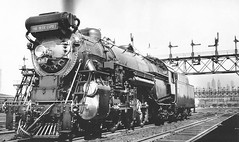
The Blue Comet #831 in Jersey City, NJ (Photo credit: Bob Reck)
The steam-engine locomotive ‘opened up’ the American West and made it more accessible to what the wagon-train pioneers sometimes derisively called ‘Easterners’. It was on those locomotive trains that the West was really ‘won’ in the Nineteenth Century. However, by the early 1950s, in the heyday of Patti Page and before Elvis hit the scene, these locomotive trains were nearly extinct.
Enter O. Winston Link, a then unknown ‘camera for hire’.
Back in 1955 when Link heard that one of the last holdouts of antiquated steam-engine technology, the Norfolk & Western Line, was going to switch over to diesel, he quietly set about doing what has come to be known by that often overblown word, ‘Photojournalism’, yet doing so with a clearly artistic touch. Link photographed the last of the steam locomotives in and around Virginia.
In so doing, Link also managed to document a society and a vanishing way of life; he ended up making “vignettes into history and sociology” that “share an era,” according to The O. Winston Link Museum.
This assessment is validated in a photograph that shows a boy pumping water from a hand pump into a bucket as a steam train chugs past in the near background. It is also reflected in a photo that shows clothes drying on a clothesline beside a switch-operator’s shack.
It is Link’s night shots, though, that steal the show.
There’s one of a man holding a little boy by the hand as a locomotive is roaring up with a puff of smoke. Notice what the boy is holding. It’s a kerosene lantern, gone the way of the more obviously obsolete technology that dominates the picture.
And there’s another mind-blowing image of cars at a drive-in with young lovers snuggling in the foreground and a steam train going left to right in the background, complete with billowing smoke (how did Link light and expose this shot?)
In other photographs the steam-engine locomotive takes the spotlight and centre stage – alone by itself in the countryside.
Link’s photography is absolutely superb and the folks behind the O. Winston Link Collection deserve a lot of credit for making so many photographs available online.

Seven Tutorials on Capturing Motion and Movement
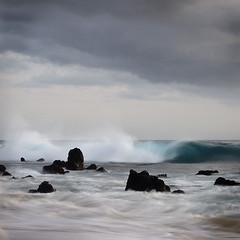
motion (Photo credit: sramtebilon)
Only two days back our post was about 100 photography tutorials spanning the gamut of topics and subject areas. Today, we look at an article listing only seven tutorials but they concentrate on a single topic: capturing motion and movement. Posted only last week on ePhotozine, these seven how-tos are the very best they’ve published on the topic.
One usually associates landscapes with stillness and rest. It may be a surprise, then, that one tutorial explains how to capture landscapes that show motion. Though the now-common technique of showing water movement and blur is covered, there’s one possibility we automatically tend to shut out. As the author puts it, “So often people worry about wind movement of trees and grasses spoiling their photographs, but why not emphasise it instead of stopping it . . .” The author demonstrates this point with a luscious photo of a tree with that satiny long-exposure effect that is so commonplace for rivers and waterfalls.
The tutorial titled Add Action to Your Photos with Blur begins with the word ‘Contradictory’ – and that’s ironic, because, ‘contradictory’ to the title of this how-to, it offers a few fine tips on freezing motion! The helpful tips on offer are many. Pre-focussing, locking focus, and continuous shooting are a few of them. This tutorial also goes into ‘zoom explosions’.
Though Add Action to Your Photos with Blur covers panning, Camera Panning Technique is dedicated to this subject. What is most useful in this how-to are all the pitfalls that is exposes and even illustrates with example photos. Read it and you’ll be forewarned of all that can go wrong so you can pan like a pro.
These three tutorials seem like the pick of the bunch but check them all out – your preferences may well be different.
In general, shutter speed, tripod, pan, ND filters, and strobe light is a basic checklist of sorts when you’re thinking ‘motion blur and movement’.
Over and above the subjects presented in these seven tutorials, keep your eyes open for day-to-day situations that lend themselves to motion blur that captures the spirit of the moment. For example, children at play and pet dogs and cats make wonderful subjects for capturing movement.

‘C’ is for Contest, ‘C’ is for Coolpix

Nikon Coolpix series (Photo credit: Wikipedia)
The ‘Hamdan bin Mohammed bin Rashid Al Maktoum International Photography Award’ competition is a mouthful of a name – and it has every right to be, as it is brimful with the green stuff. It has a humongous prize pot of $389,000 and the grand prize itself is a whopping $120,000!
Check out HIPA’s website and see if you think you think you want to try your luck in any of the four categories.
You know there’s going to be lots of intense competition so perhaps you want to try something that’s not quite so competitive but still has a big fat prize? Try ePhotozine’s Competition which has a daily theme and gives away four Nikon Coolpix cameras per month.
Did I write “not quite so competitive”? Oops— scratch that!
Regardless of whether or not you enter either competition, it pays to at least look at the entries, especially winning ones, because the very act of doing so will allow you to learn something. Because, for most contests, it costs nothing to enter, you may as well match your skills and take a shot at winning . . . say, a Coolpix!
Talk of Nikon’s Coolpix, is this the new face of that simple, snapshot camera?
Some ‘enthusiast’ cameras pack in so many useful features and impressive specs that they allow amateur photographers to grow and progress toward the next level. In similar fashion this Coolpix, the P7700, would allow the novice photographer to grow and progress toward the next level, that of an amateur or enthusiast – but with a different twist:—
The P7700 is not crammed with different exposure modes; rather, it has the four traditional exposure modes from the days of yore (plus a programme mode). This limitation will let – or make – the serious novice learn the principles of exposure. It also has interchangeable lenses (of course), a vario-swivel LCD screen, EV compensation, and more useful features.
At the same time, it does have separate dials for ‘Scene Modes’ and ‘Effects’ which too will let the newbie continue on his/her learning curve. This is a smart design – a smart design for a smart camera series that thoroughly deserves its reputation and popularity.

Landscape Photography and Aspect Ratios
So many ‘rules’ and guidelines govern photography, including landscape photography. However, the all-important choice of aspect ratio ‘enters the picture’ as only an afterthought during post-processing. Instead, the aspect ratio ought to visualized at the time of taking the photograph in order to maximize your chances of nailing an appealing landscape. That is Elliot Hook’s premise in Aspect Ratios in Landscape Photography.
From this position, Hook proceeds to take the reader through generally-accepted aspect ratios. He explains the effects each has upon the eye and perception and also what the strengths are of each.
Note that Hook’s tutorial is about “Landscape Photography.” As such, aspect ratiosthat are higher than they are wider (what you get by turning the camera 90 degrees) ar

Aspect ratios (Photo credit: Wikipedia)
not discussed in any detail but are mentioned at the end. That doesn’t mean you cannot or should not use a portrait orientation for a landscape. A minority of situations in landscape photography – e.g. cliffs, gorges, waterfalls – lend themselves to a portrait orientation. Pronounced vertical aspect ratios can heighten dramatic impact.
Starting with a 1:1 ratio – a square – Hook says that it can be used to “give a subject a striking presence at the centre of the frame” and that it “lends a good opportunity to break the rules we so often follow.” Simply trying out Hook’s recommendations will easily prove their worth.
Hook differentiates between different ‘landscape format’ aspect ratios. He says that relatively narrower ones, like 4:3, are useful when wants to lead the eye from the foreground to the landscape itself. In contrast, wider aspect ratios like 16:9 (and even wider) invite the eye to travel horizontally – ‘sweep’ the image. They are best used to represent a ‘pure’ landscape; a distant scenic panoramic view.
Another element is also in the mix: focal length. Hook associates each aspect ratio not only with what photographic material it will work best for, but also with suitable and appropriate focal lengths. For instance, he suggests using “longer focal lengths” for images with a 16:9 aspect ratio. This article provides many similar guidelines.

Weekly Roundup: From the Unusual to the Weird
Hurricane Sandy
Yesterday’s post contained a link to a photo of Hurricane Sandy from space. Today let’s see Sandy up close and personal from the street, courtesy of some skilled – and intrepid – photographers.
You’ll see flooded roads, submerged cars, 20-foot waves, power outages, and New York in distress in this album. See the locals getting alarmed and making preparations and cleaning up the wreckage further south down America’s East Coast and the Caribbean in this album. Now these photos are great examples of that much-used word, ‘Photojournalism’.
Sandy also brought about some unusual nature-made photographic effects further north in Syracuse. There, photographers didn’t need any filters to shoot photos of an otherworldly peach-pink sky. Sometimes it’s just about being in the right place at the right time!
Alien Effects, Alien Figures
Some Sandy-like effects can be created artificially by talented craftsmen. Have a look at these equally arresting, slightly otherworldly landscapes which the photographer, Matthew Albanese, calls ‘Strange Worlds’. These landscapes are indeed ‘strange’ because they’re all shot inside his studio! Surely that’s not giving away the game too much?
Just as ‘strange’ is Chris Bucklow’s people photography . . . for he takes photographs without any camera! Bucklow’s visually striking and artistic images also make no use of Photoshop; he uses a rudimentary yet advanced technique using a cardboard on which a figure is mapped out with “thousands of pinholes.”
Voyage to the Bottom of the Sea
Even though we close with a ‘straight’ photography item, this one too is well off the beaten track: you see, it’s about an underwater shoot . . . and the subject is turtles! Closer to home, Australian Geographic reports that Doug Perrine has taken the first underwater photographs of flatback turtles.
The eight-image album is worth a view even though it offers no tips for aspiring underwater photographers – heck, it’s probably rather unlikely anyway that you’ll be pulling a ‘Thunderball’ anytime soon!

 Follow us on Facebook for all the latest in canvas printing news and exclusive deals!


.jpg)